
Caseload & Budget Analysis: First Year Projections of Raise the Age Legislation
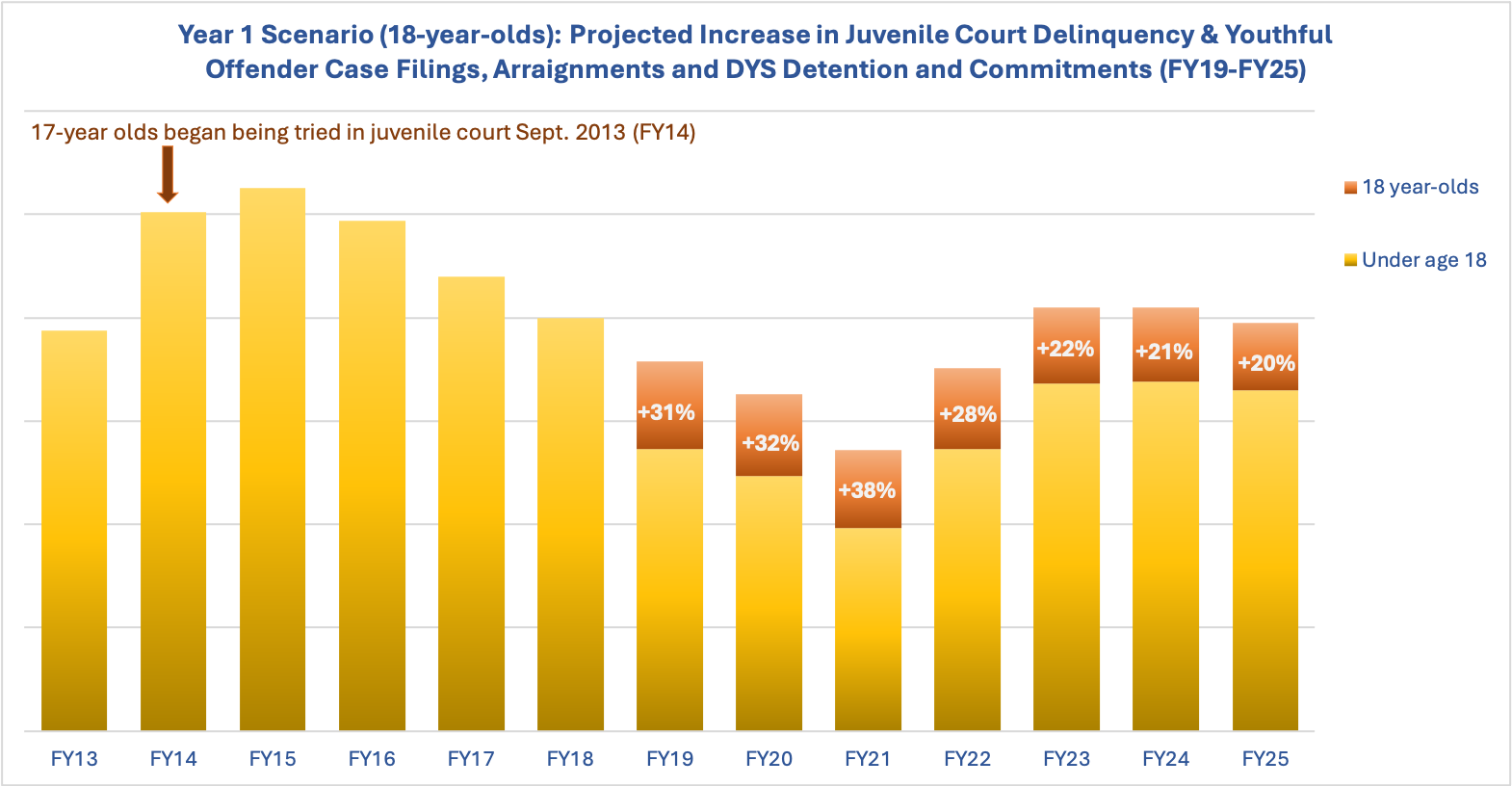
Had Raise the Age passed, with 18-year-olds included in juvenile jurisdiction in FY2025, the Juvenile Court and DYS would have experienced 1,076 arraignments, 175 detention admissions and 45 commitment admissions. This represents an overall 20% increase over their intake that year, and would still remain below FY2018 levels. On average, 58% of Juvenile Court filings result in an arraignment, 13% DYS detention admissions, and 3% result in DYS commitment admissions. We utilize these estimates to project the caseload impact on DYS had Raise the Age passed and been implemented during this five-year stretch.
From FY2018 to FY2026, DYS, DOC and all HOCs have seen steep reductions in admissions, however, HOCs and DOC spending increased by 20% (+$125 million) and 39% (+$251 million), respectively, while DYS’s budget increased by only 5% (+$9 million). CfJJ also analyzed the fiscal impact of the caseload change on DYS , DOC and Houses of Correction budgets. During fiscal years 2018-2025, admissions to all HOCs dropped by 33% but their and admissions to DOC dropped by 52%. In contrast, DYS admissions decreased by 28% during that period and its budget has remained relatively stable. Given the juvenile system’s lower recidivism rate and increased utilization of diversion, shifting 18-year-olds may require a shift in financial resources from the adult system (District/Superior Courts, HOC/DOC) to the juvenile system (Juvenile Court/DYS). The return on investment in those shifted dollars would result in better outcomes and lower recidivism, which would pay dividends for the state as we face a tough fiscal climate. The Washington State legislature conducted a full implementation, caseload and cost-benefit analysis and concluded that Raising the Age for 18-20-year-olds “ will drive net cost savings of between $12 million and $20.3 million over the first five years of implementation […] project the need for an additional $1.9 million - $2.8 million in net costs to cover the shift from adult jail to juvenile detention.”
All youth admitted to DYS programs, with the exception of overnight arrests, are engaged in programming. The Correctional Funding Commission found that HOCs and DOC spend only between 1% and 5% of their budget on all programming. In dollar terms, DOC spends under $2,000 in programming per incarcerated person, and most HOCs spend between $3,000 and $6,500, with outliers of Bristol (under $1,500) and Berkshire (above $7,500). Unlike adult corrections, the Department of Youth Services’ programs ranged from community-based pre-arraignment diversion to post-commitment voluntary services:
MA Youth Diversion Project: all youth referred to MYDP are engaged in programming. MYDP is a recently created program that allows police, prosecutors, clerk magistrates and juvenile court judges to refer youth pre-arraignment for assessment and diversion programming.
Overnight Arrests: youth held temporarily overnight or weekends until courts are open, due to the short-term nature, programming is limited to emergency healthcare services
Detention: all youth held in pre-trial detention are engaged in educational programming and emergency health services.
Commitment: all youth committed to DYS are engaged in educational (high school, vocational, post-secondary), therapeutic, preventative and chronic health services and other programming.
Youth Engaged in Services: Between 60-65% of youth return to DYS post-commitment to engage in educational, employment and housing case management services.
Data on programming in adult corrections is very limited, but available for educational programming. The scale of unmet need is significant: In December 2021, there were 886 people (or just under 15% of the total population) enrolled in educational classes at DOC. At the same time, 4,065 people—more than 67% of the incarcerated population—were on waiting lists for adult basic education and adult secondary education. Given that DOC invests only 1.9% of its budget on program costs, this unmet demand for educational programming is unsurprising.
Raising the Age of the juvenile court jurisdiction is the most cost-efficient way to ensure that the older adolescent population that is currently being managed poorly by the HOCs and DOC. Both adult and DYS populations have gone down over the last 15 years, yet DYS spending has been flat, and adult spending has gone up almost 25 per cent. The Department of Youth Services (DYS) has the capacity, infrastructure, and already is in custody of 18–20-year-olds under the Youthful Offender statute. While there is significant hype and some small young adult units with improved programming and practices in a small number of houses of correction, these only reach a tiny percentage of the emerging adults; many others are in restrictive housing spending 22.5 hours a day in isolation. We have within Massachusetts, a DYS system that has achieved better public safety outcomes than the adult system; all at a fraction of the cost of what it would take to get the adult corrections system to bend away from its punishment focus.
Methodology
This analysis estimates the first year caseload impact of legislation to raise the age of juvenile court jurisdiction to include 18 year olds, utilizing publicly available data from the Juvenile Court, Trial Court and Juvenile Justice Policy and Data Board to document legal system involvement trends from 2018 to 2026. This analysis compares the Trial Court’s data on case filings in the Juvenile and District Courts and the number of Department of Youth Services (DYS) detentions and commitments during those same years.